Diese Seite ist noch nicht ins Deutsche übersetzt; der englische Originaltext wird angezeigt.
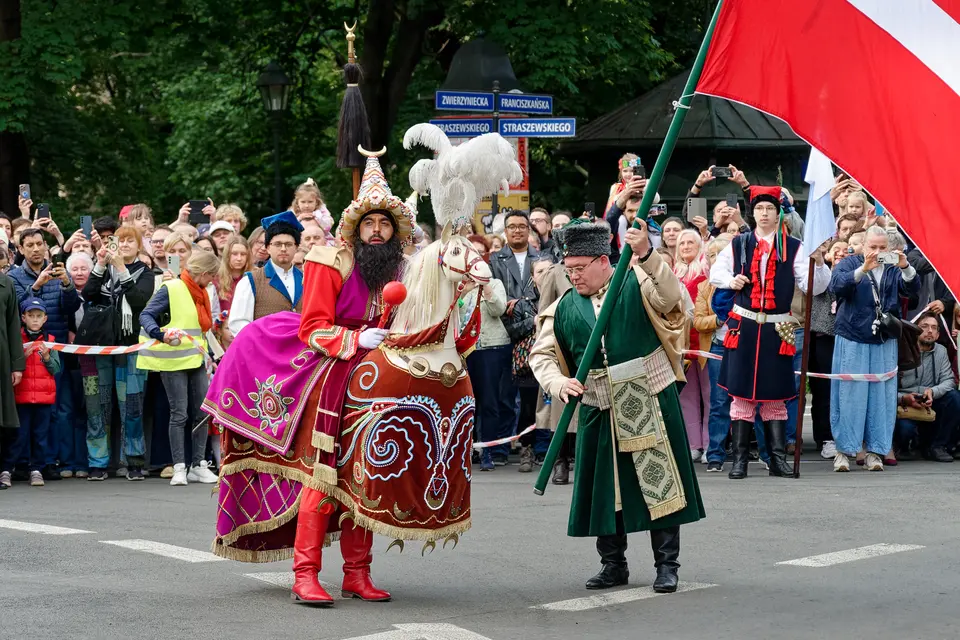
On the first Thursday after Corpus Christi, a bearded rider in a red Tatar costume, with a wooden horse around his waist, dances through Kraków with a band and an escort of “Tatars”, tapping passers-by with his mace for luck before toasting the city with the mayor.
The Tatar rider
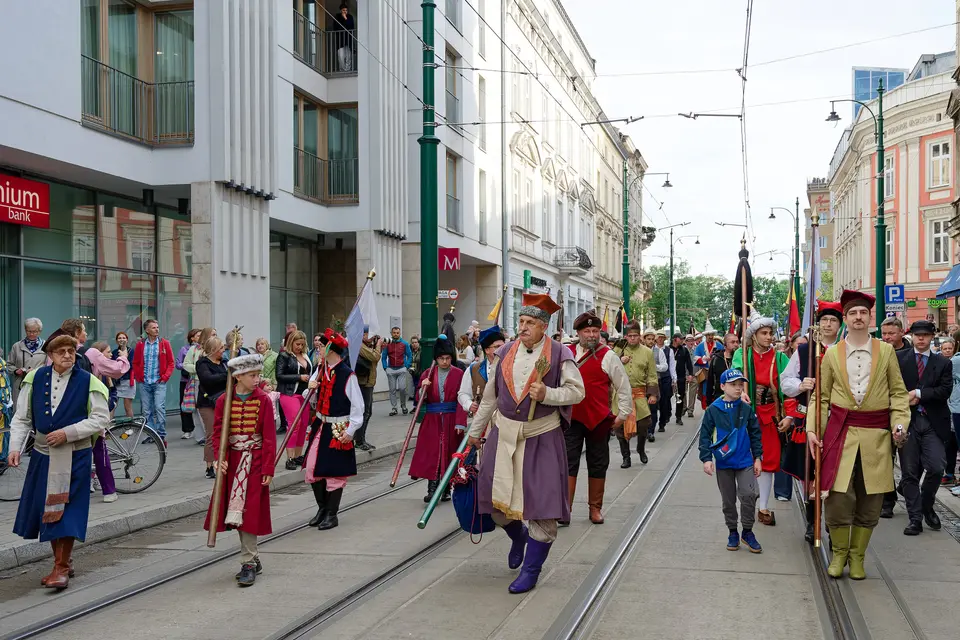
The Lajkonik — also called the Tatarzyn or Konik zwierzyniecki — is a bearded horseman in quasi-oriental costume with a hobby horse around his waist, and one of the informal symbols of Kraków. On his day he wanders the backstreets of the Zwierzyniec district and the Old Town, giving symbolic blows with his mace to restaurateurs, shopkeepers and passers-by and collecting tribute in baskets. He is accompanied by rafters, the włóczkowie, dressed in Tatar-style costumes, and by the Mlaskoty band, folk musicians playing Kraków tunes on flute, trumpet, clarinet, accordion, drum and violins.
The parade sets off from the headquarters of the Kraków Waterworks on Senatorska Street, stops at the market on Plac na Stawach and then at the Norbertine Monastery in Salwator, where the Lajkonik dances in the courtyard and tries to strike the eagle on a large white-and-red flag with his mace. It then follows the same route every year to a stage by the Town Hall Tower on the Main Market Square, where the Lajkonik and the mayor raise a toast to the prosperity of the people of Kraków.
Legend and history
The origins of the parade are shrouded in legend, but it was shaped by the memory of the Mongol-Tatar invasions of the Middle Ages; one of them ravaged Kraków in 1241. A legend first written down in 1820 tells of the Włóczkowie, rafters who floated timber down the Vistula, defeating the Tatars around 1281; their leader put on the khan’s costume and rode his captured horse into the city. At the end of the eighteenth century the Bishop of Kraków is said to have banned the Lajkonik from the city, and the tradition survived thanks to the rafters and their descendants in Zwierzyniec. Around the turn of the twentieth century the painter Stanisław Wyspiański designed the costume still worn today, with its fiery red colour and lighter headdress. In 1936 the city made the parade the centrepiece of the Days of Kraków, and it is supervised today by the Museum of Kraków.
Wann es stattfindet
The parade takes place every year on the first Thursday after Corpus Christi, which falls between late May and the start of July because it depends on Easter. It is the centrepiece of the Days of Kraków festival.
- 3. Juni 2027Berechnet
- 22. Juni 2028Berechnet
- 7. Juni 2029Berechnet
- 27. Juni 2030Berechnet
Respektvoll besuchen
Gut zu wissen
- A tap from the Lajkonik’s mace is said to bring good luck — and so does paying him tribute.
Quellen
Dieser Eintrag beruht auf den folgenden Quellen.
- Lajkonik paradeKraków Heritage (City of Kraków) · abgerufen am 17. September 2026
- LajkonikWikipedia · abgerufen am 17. September 2026
- Poland travel advice: safety and securityUK Foreign, Commonwealth & Development Office · abgerufen am 17. September 2026
Verwandte Feste
Kraków Nativity Scene Contest
Konkurs Szopek Krakowskich
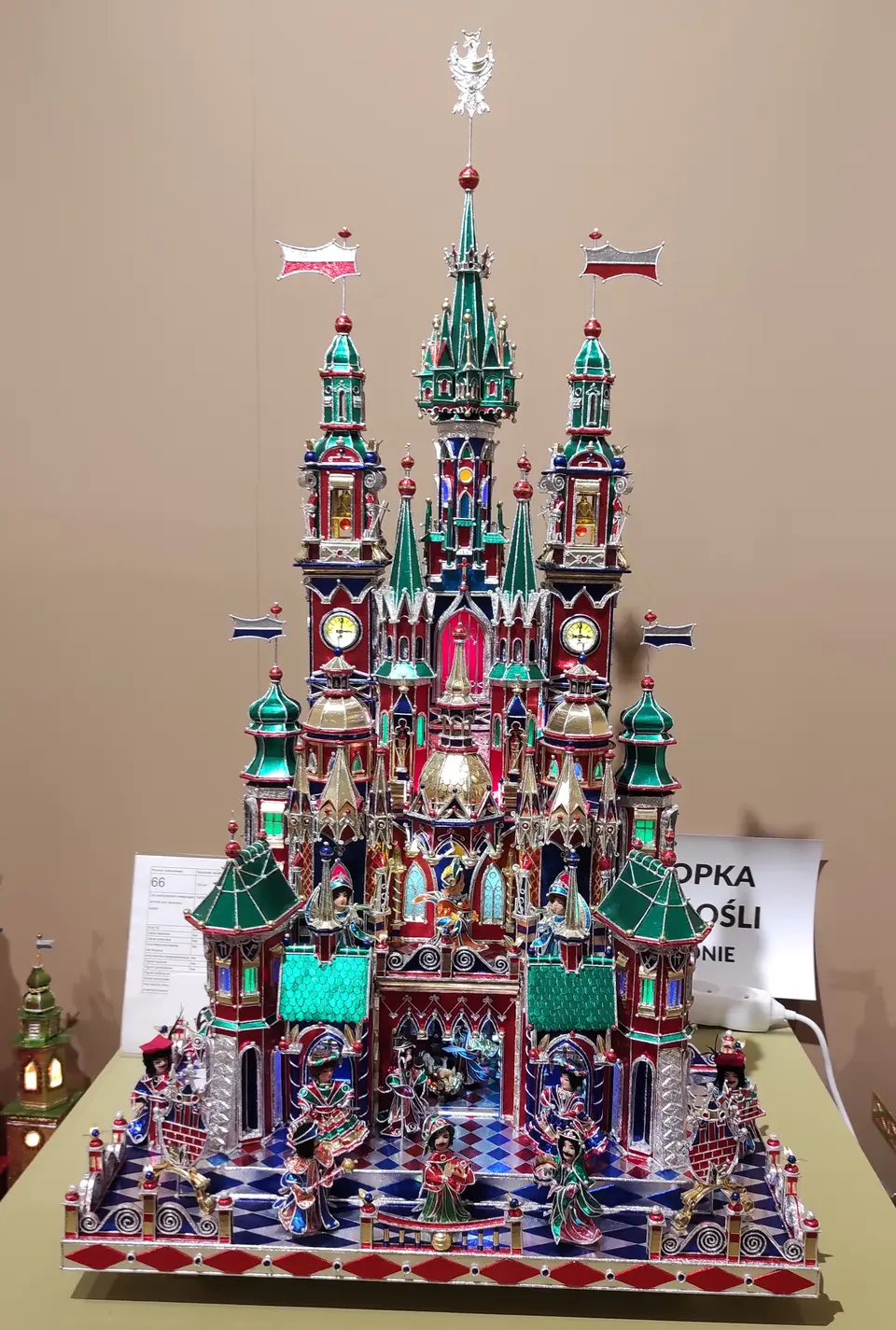
On the first Thursday of December, hundreds of makers carry their szopki — nativity scenes shaped like Kraków’s churches, towers and cloth hall, glittering with foil and coloured paper — to the steps of the Mickiewicz monument on the Main Market Square to be judged.
3. Dezember 2026Berechnet
Ducasse de Mons (Doudou)
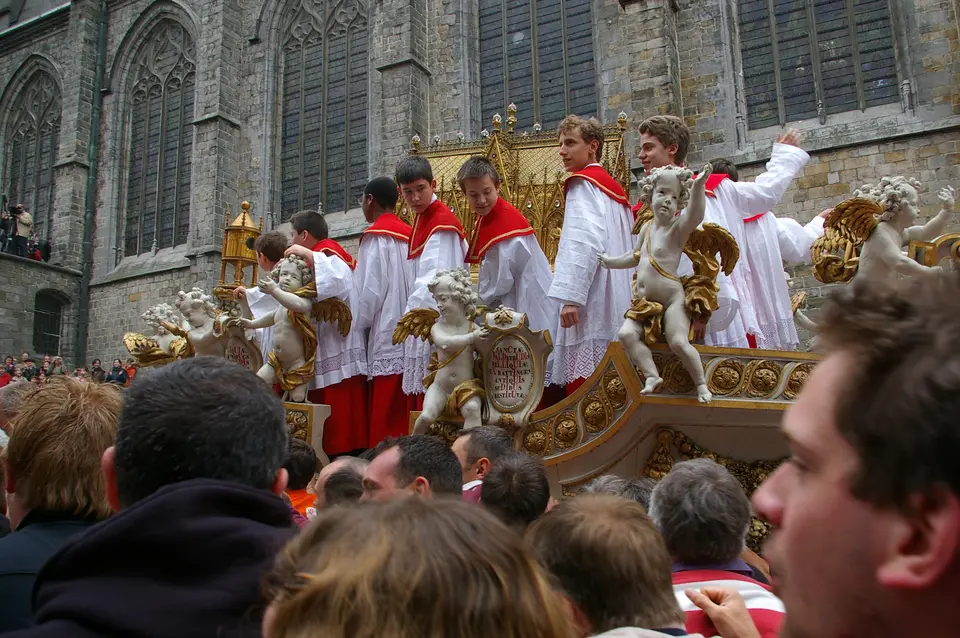
On Trinity Sunday, Mons carries the shrine of its patron saint through town on a golden chariot that the crowd must push up a steep cobbled slope in one go — and then, on the Grand-Place, St George fights the dragon in the frantic half-hour combat called the Lumeçon.
22.–23. Mai 2027Berechnet
Corpus Christi in Cusco
Corpus Christi del Cusco
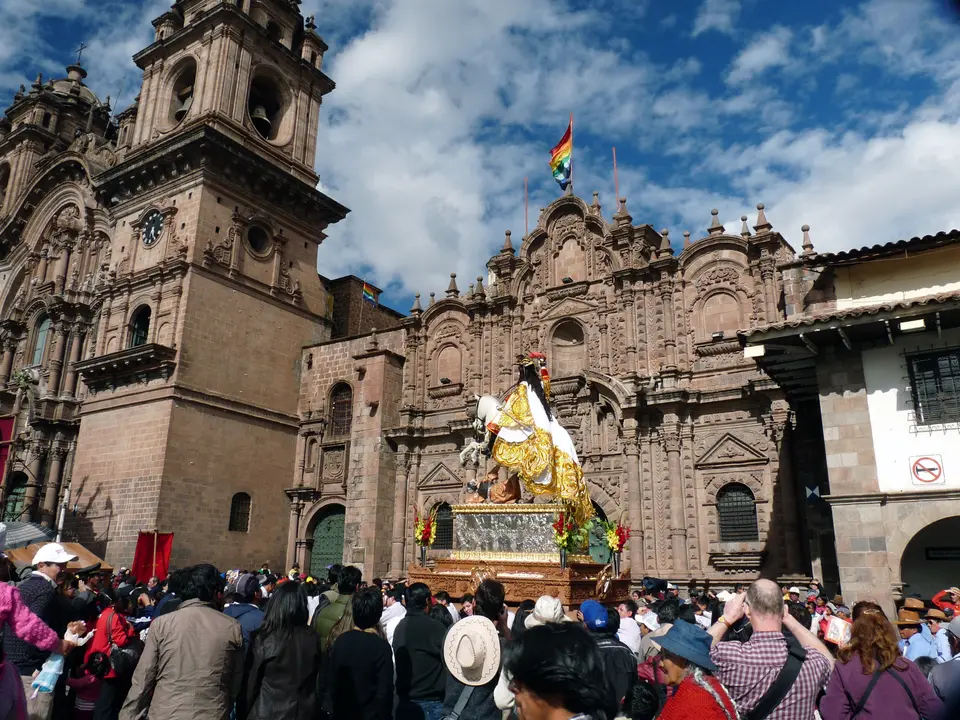
On the feast of Corpus Christi, the parishes of Cusco carry fifteen images of saints and virgins into the Plaza de Armas, where they process with the cathedral’s gold and silver monstrance and then stay in the cathedral for a week — a Catholic feast shaped by centuries of Andean devotion and rivalry.
26.–27. Mai 2027Berechnet