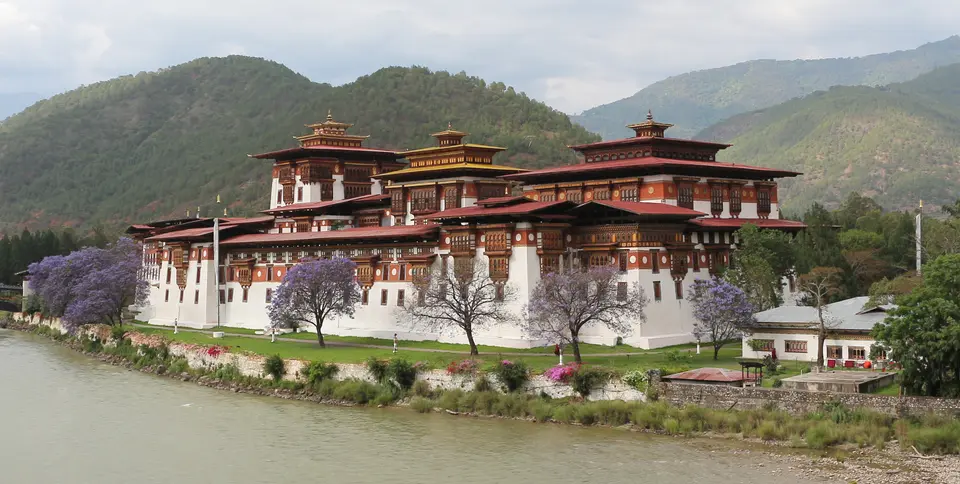
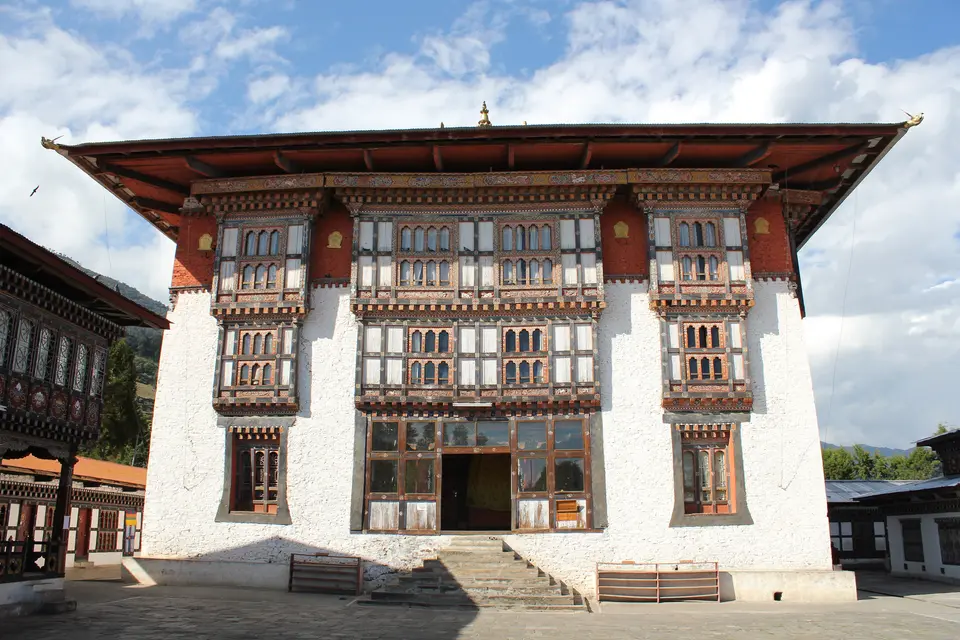
Punakha Dromchoe
Photo: Bernard Gagnon, CC BY-SA 4.0, via Wikimedia Commons
Men from nine village blocks dress as warriors and fight the battle of 1639 again in the courtyard of Punakha Dzong, between two rivers. Three days of that, then three days of mask dances, and at the end the Je Khenpo throws oranges into the Mo Chhu.
The winter capital, and a battle
Punakha Dzong was built by Ngawang Namgyal, the first Zhabdrung, in 1637 and 1638, on the tongue of land where the Pho Chhu and the Mo Chhu meet. Two years later a Tibetan force came for it, and for the relic kept inside — the Rangjung Kharsapani, which the Zhabdrung had brought out of Tibet and which stood for his right to rule. The Tibetans were defeated in 1639, and the Dromchoe re-enacts it.
The pazap
The warriors are called pazap. They are not a troupe: every year the gewogs of Punakha and Thimphu choose men to fill the ranks, in traditional dress, to re-enact the victory over the Tibetan forces in the time of Zhabdrung Ngawang Namgyal. The national broadcaster, reporting on the 2026 festival, counted 160 pazap from Wang Tshochen Gye and Lingmukha gewog alone, nearly half of them young, and described local leaders coaxing boys to come forward now rather than compelling men later, so that the tradition keeps going. Wikipedia's account of the dzong puts the full display at 136 pazap.
The oranges
The festival ends at the water. The Je Khenpo, the head of the monastic body, goes down to the Mo Chhu and throws oranges into the river; they stand for the Rangjung Kharsapani and are an offering to the nāgas. Mask dances follow, commemorating the building of the dzong, and then the three days of the Tshechu proper begin.
When it falls
The Dromchoe opens on the ninth day of the first month of the Bhutanese calendar, which lands in February or March. The Association of Bhutanese Tour Operators lists 13 to 15 February 2027 for the Dromchoe and 16 to 18 February for the Tshechu, under a heading that says tentative and a note that dates are tentative until the dzong confirms them. In 2026 the two ran from 23 to 25 and 26 to 28 February.
When it happens
The Dromchoe begins on the ninth day of the first month of the Bhutanese calendar, in February or March, and the Tshechu follows it. The tour operators' association lists 13 to 15 and 16 to 18 February 2027 and marks both tentative.
- February 13 – 15, 2027Dromchoe, the days of the warriorsEstimated
- February 16 – 18, 2027Tshechu, the mask dancesEstimated
Visiting with respect
Good to know
- The men in warrior dress are not actors hired for the day. They are chosen by their gewog and they are doing something their village owes.
- Dress as you would for a temple, and take a hat off inside the dzong.
- Ask your guide before photographing the pazap or the procession to the river.
- Punakha is warm compared with Thimphu, but it is still a dzong. Cover shoulders and knees.
Avoid
- Do not walk into the formation during the re-enactment, or stand in the gap the procession will come through.
- Do not handle a pazap's sword, shield or headdress.
- Do not smoke on the grounds.
Stay safe
- The courtyard and the riverbank fill up. Move with the crowd rather than across it.
- The road from Thimphu crosses the Dochula pass and can be closed by snow in February; allow for that.
- Road accidents are one of the biggest causes of injury and death in Bhutan. Avoid travelling at night.
Sources
This entry was written from the following sources.
- Punakha DzongWikipedia · read September 25, 2026
- Youth step forward to preserve pazap tradition at Punakha DromchhoeBhutan Broadcasting Service · read September 25, 2026
- Tentative festival dates for the year 2027Association of Bhutanese Tour Operators · read September 25, 2026
- Bhutan travel advice: safety and securityUK Foreign, Commonwealth & Development Office · read September 25, 2026
Related festivals
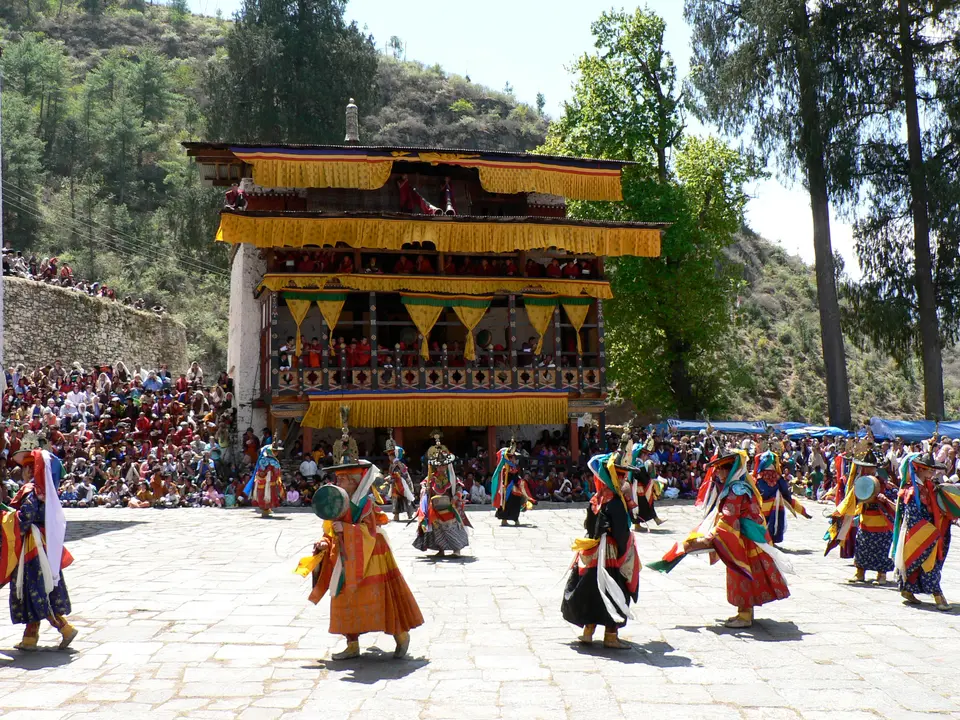
Paro Tshechu
Five days of masked dance in the courtyard below Rinpung Dzong, and then, on the last morning before dawn, a scroll the size of a three-storey building is raised in the dark, looked at by thousands of people, and rolled away again before the sun reaches it.
March 18 – 22, 2027Estimated
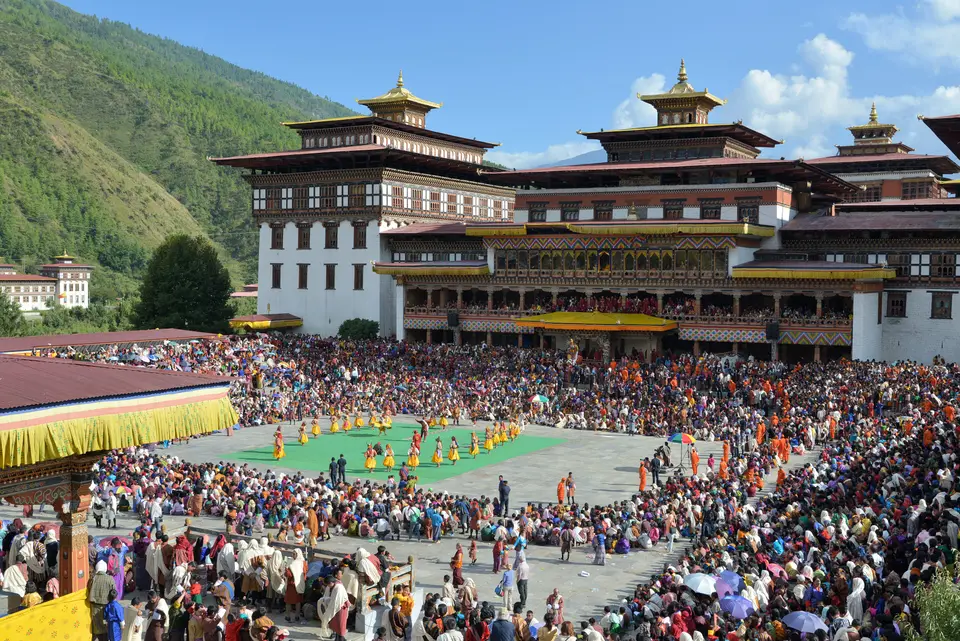
Thimphu Tshechu
The capital's tshechu fills the courtyard of Tashichho Dzong for three days in autumn. It is the one Bhutanese festival that most people in the country have been to, and the seat of government becomes, for those days, a dance ground with several thousand people sitting around it.
October 10 – 12, 2027Estimated
Drametse Ngacham
Sixteen men in animal masks and monastic robes, each with a drum, dance at one monastery on a ridge in eastern Bhutan. UNESCO inscribed it in 2008. It is offered twice a year at Drametse itself, and by now it is danced at tshechus all over the country.
Comments
Have you been there? Tell other readers what to expect.
No comments yet.
Comments are read by the site’s owner before they appear.