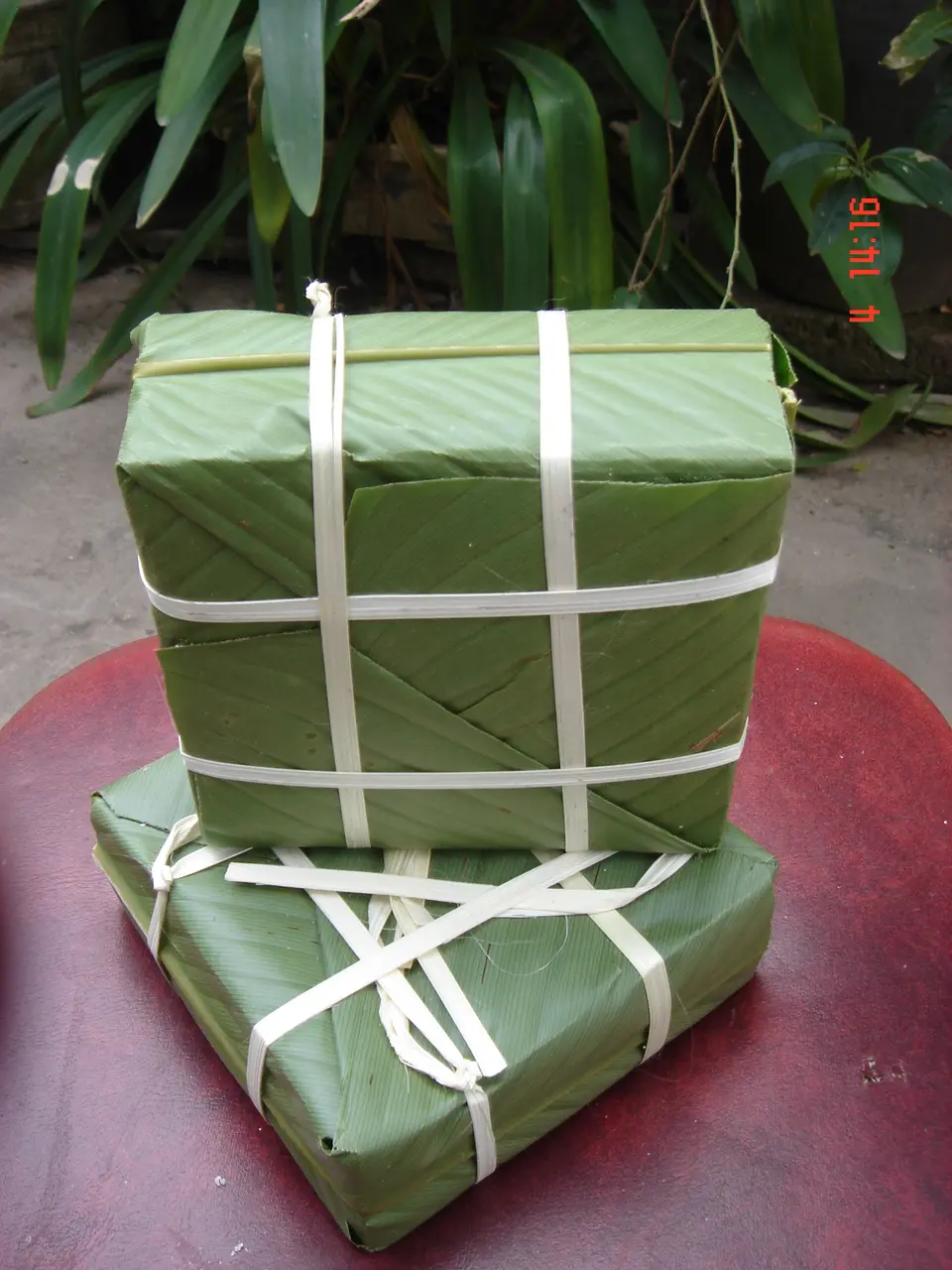
A square brick of glutinous rice, mung bean and pork, wrapped in dong leaves and boiled for ten to twelve hours. A prince is said to have won a kingdom with it by making the plainest thing at the contest. It is the food of Tết, and it is cut with the string that tied it.
A brick of rice
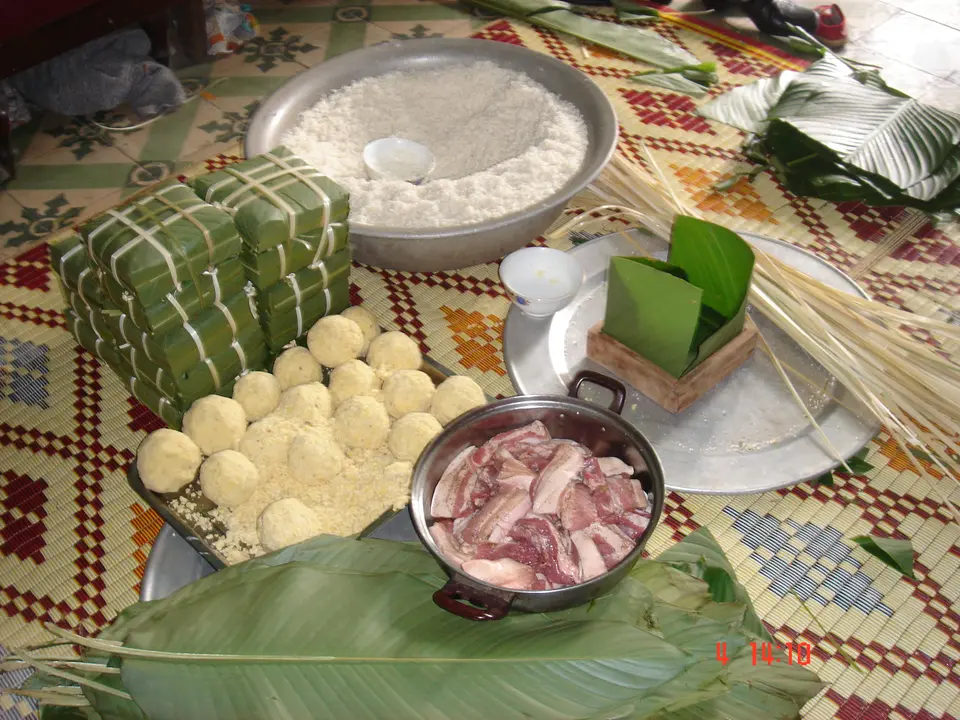
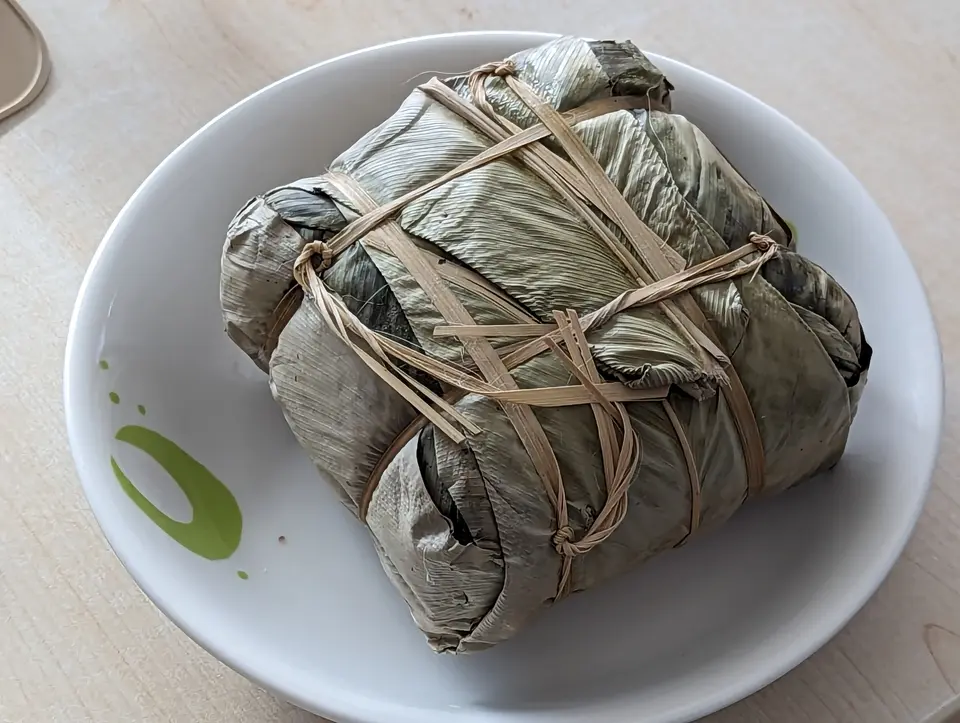
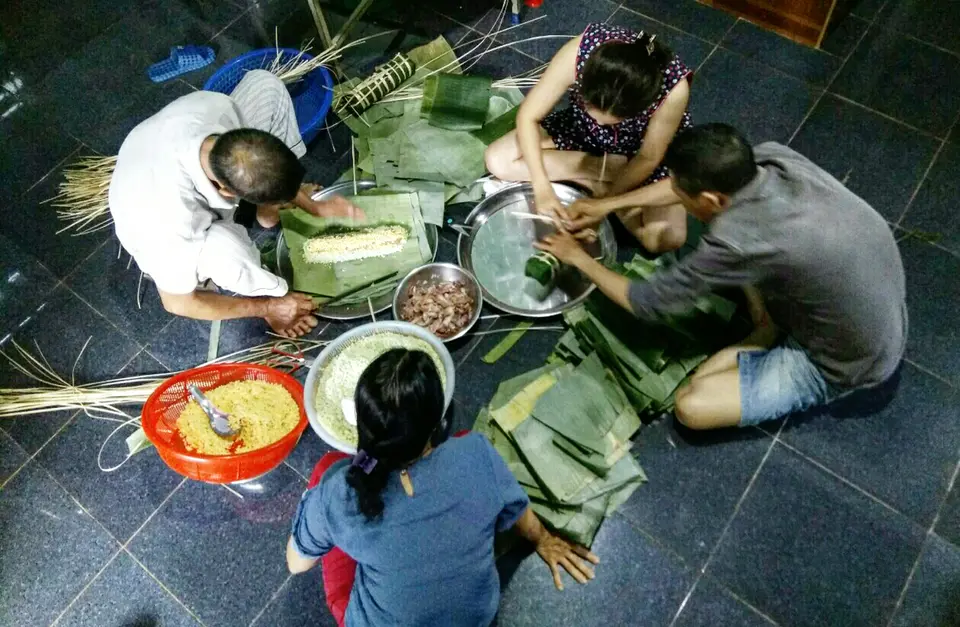
Bánh chưng is a square cake of glutinous rice with mung bean and pork inside it, wrapped in lá dong leaves and tied with strips of giang bamboo. It is built in layers rather than filled: the strings and the leaves go down first, then rice, then a layer of mung bean paste, then slices of fatty pork, then more mung bean, then rice again to close it. Black pepper and salt season it, sometimes green onion, and nước mắm gives it the salt it needs.
Then it is boiled. The cakes are packed into a large pot with chopsticks or bamboo between them so the water can move, and they cook for ten to twelve hours while someone tops up the water as it goes. That is the whole reason bánh chưng is a New Year food and not a weeknight one: a household does it once, in quantity, in the days before Tết.
The prince who made the plainest thing
The story is in the Lĩnh Nam Chích Quái. The sixth Hùng King set his sons a contest: whoever brought the finest dish would have the throne. The other princes went out for rare and expensive things. Lang Liêu, who had no such means, was told in a dream to make something out of what people actually live on, and he brought two cakes of rice — one square, one round.
The square one is bánh chưng and stands for the earth. The round one is bánh giầy and stands for the sky. Together they were taken as the proper way to honour ancestors, and Lang Liêu got the kingdom. It is a founding story about a food, which is unusual, and it is also an argument about what an offering is for.
The string
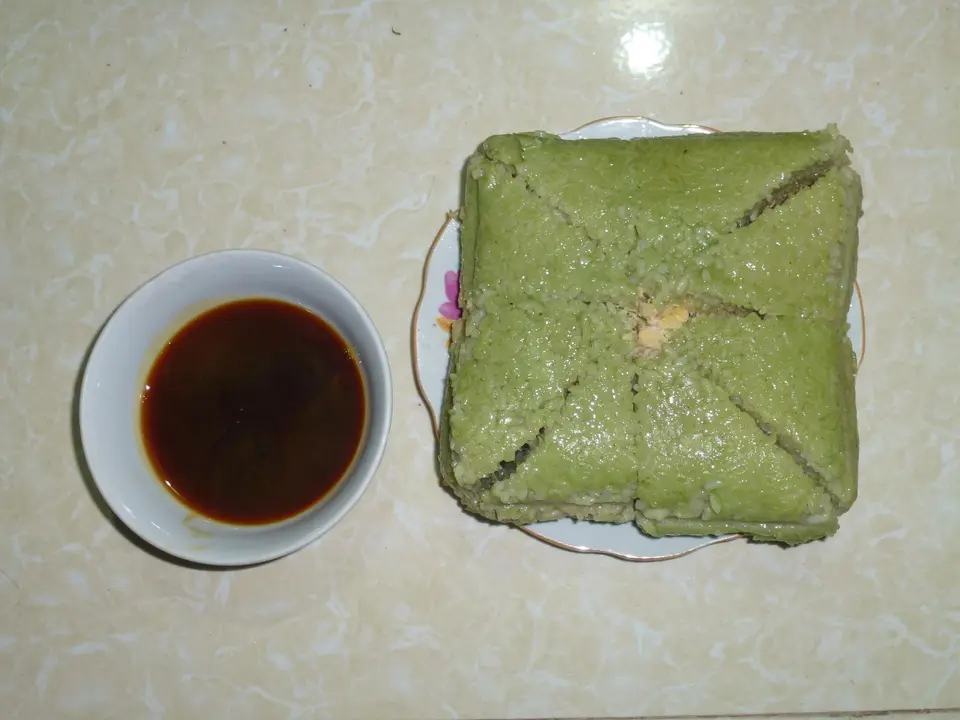
A finished cake is cut with the bamboo strip that tied it, not with a knife. The string is drawn through the cake diagonally, corner to corner, and again the other way, so that the mung bean and the pork in the middle are divided evenly instead of ending up in whichever piece the knife happened to favour. One cake gives eight triangles, or nine squares if it is cut on the straight.
It keeps. A long bánh chưng of the northern kind, made with little or no pork so that it lasts, will hold for up to three months.
North and south
The square is the northern shape. Southern Vietnam makes the same rice, beans and pork as a cylinder, bánh tét, sliced across into rounds. The north also makes bánh tày, a long bánh chưng with little or no pork in it, which is what allows it to be kept.
It is served cut, with pickled onions or pickled vegetables to cut the fat, with chả lụa — the pale pork sausage — and with nước mắm. Before any of that, the cakes are placed on the family altar, to honour the ancestors and to ask their help in the year that is starting.
When it is eaten
Tết, the lunar new year. The wrapping and the boiling are done in the days before, and the cakes sit on the family altar before anyone eats them.
Where you will meet it
- A kitchen or a courtyard in the last days before Tết, around a pot big enough to hold a dozen cakes for half a day.
- The family altar, where the cakes are set to honour the ancestors before the household touches them.
- Northern Vietnam, which keeps the square shape. In the south the same idea is rolled into a cylinder and called bánh tét.
- The market in the week before the new year, where the leaves, the rice, the beans and the pork are bought together.
The atlas names occasions and kinds of place, never a particular restaurant. We cannot read a kitchen from here, and a recommendation we could not check would be worth less than none.
What goes into it
- Glutinous rice, the outer and inner layers both.
- Mung beans, cooked and made into a paste, laid in two layers around the meat.
- Fatty pork, sliced, in the middle.
- Black pepper and salt, sometimes green onion, and nước mắm for the salt of it.
- Lá dong leaves to wrap it, and split giang bamboo to tie it.
At the table
Good to know
- The cakes go on the altar first. Eating one before the ancestors have been offered it is not done.
- Cut it with the string it was tied with rather than a knife — the string is pulled through the cake and every piece comes out with the same amount of filling.
- It is eaten in company, with pickled vegetables and chả lụa, not alone as a snack.
Avoid
- Do not call it a dumpling. It is a layered construction, not a filling in a wrapper, and the layers are the point.
- Do not unwrap a cake and leave it. Once it is open it dries fast; a whole one keeps for weeks.
- Do not assume the southern one is the same thing under a different shape. Bánh tét is rolled, sliced into rounds, and a different tradition of its own.
Sources
This entry was written from the following sources.
- Bánh chưngWikipedia · read September 29, 2026
- Bánh chưngWikipedia tiếng Việt · read September 29, 2026
Eaten at
Tết
Tết Nguyên Đán
The Vietnamese Lunar New Year is the most important celebration in Vietnam — a time to go home, tend ancestors’ graves, fill the house with peach or yellow ochna blossom, wrap sticky rice cakes, and take care over who crosses the threshold first.
February 6 – 8, 2027Calculated