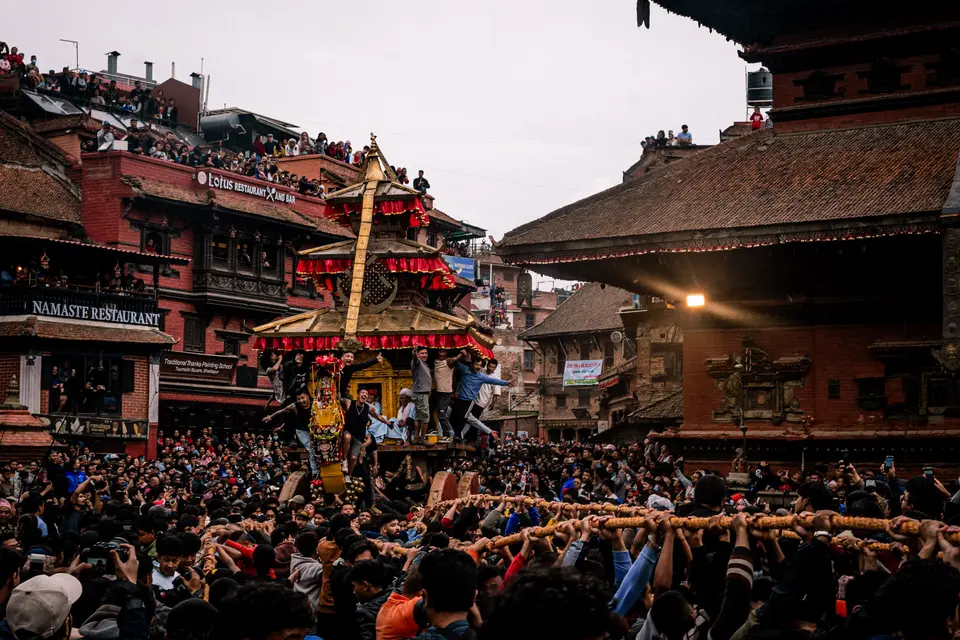
Bhaktapur brings out two chariots for the new year and lets the two halves of the town fight over them. A tall wooden pole is raised at the edge of the city and pulled down again on the last night of the old year, and the year turns when it falls.
The princess and the serpents
The story Bhaktapur tells is of a princess whose bridegrooms kept dying in the night. A young man, advised by a goddess, stayed awake to watch, and saw two serpents come out of the sleeping princess's nostrils; he cut them down with his sword. The festival is said to begin with him displaying the two dead serpents — and the long streamers on the Yosin pole are read as those serpents to this day.
Two chariots and a pole
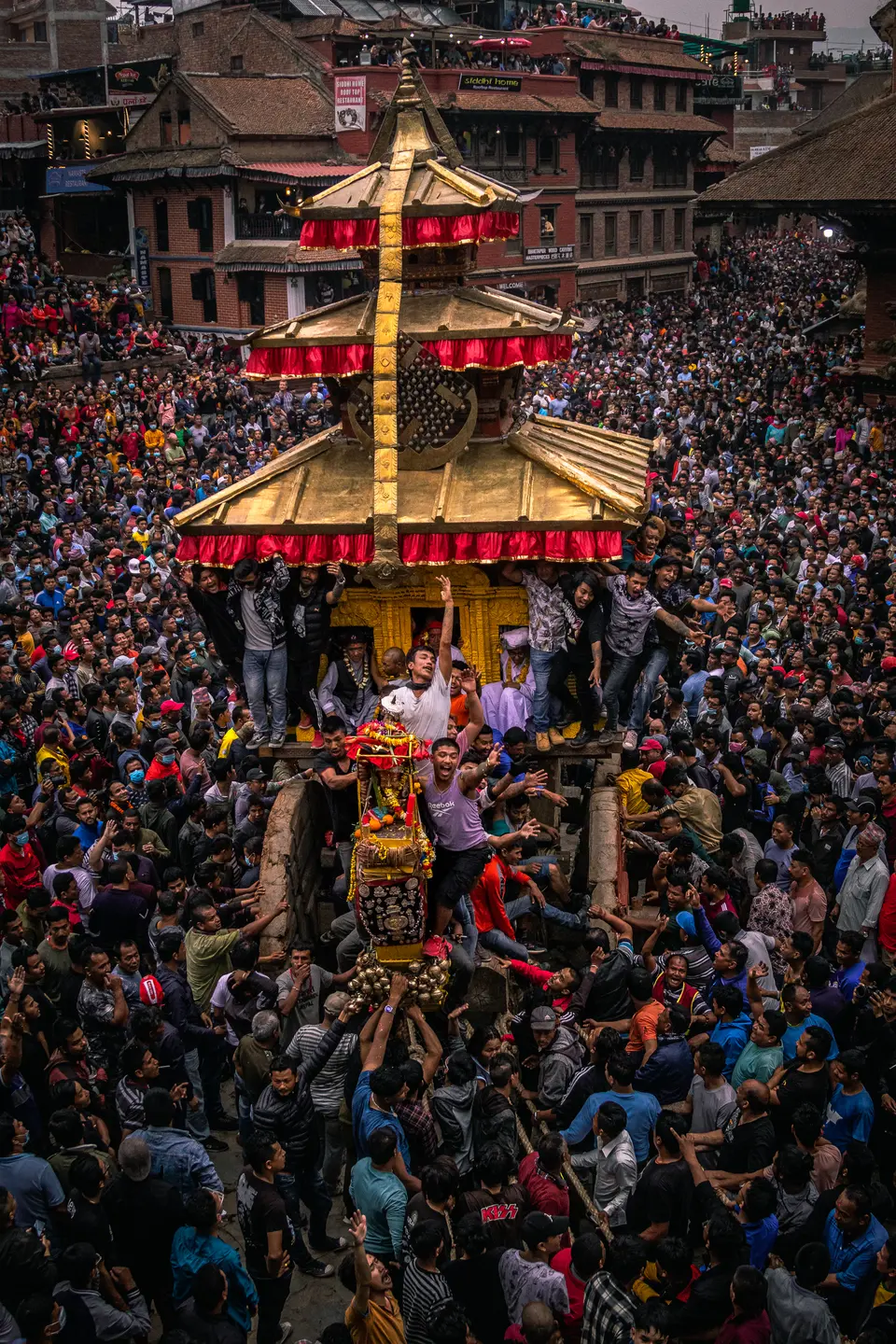
The centre of the festival is at Taumadhi Square, where the chariot of Bhairava — a heavy, tiered thing on solid wheels — is brought out with the smaller chariot of the goddess Bhadrakali. The men of the upper town and the men of the lower town take the ropes at opposite ends and pull against each other; the half that wins takes the chariot to its own quarter. The chariots are hauled through the city over several days and end back at the temple.
At Yosin Khyo, at the lower end of the town, a tall wooden pole is raised with the serpent banners hanging from it. On the last evening of the old year it is pulled down. The year begins when it hits the ground.
The neighbouring towns keep their own days in the same week: Thimi throws vermilion powder over the palanquins of its gods in the morning of the new year, and at Bode a man walks through the town with an iron spike through his tongue, carrying torches on a rack on his shoulders.
When it happens
Nepal's official year, Bikram Sambat, begins on the first day of Baisakh, which falls on 13 or 14 April in our calendar. Bisket Jatra straddles it — roughly four days before and four days after — so unlike Dashain and Tihar it comes back to almost the same dates every year. The exact programme, day by day, is announced in Bhaktapur in the weeks before.
When it happens
Bisket Jatra is one of the few Nepali festivals fixed to the solar year rather than to the moon. It runs about nine days around the Nepali new year, which falls on 13 or 14 April, so it usually begins around 10 April. Confirm the programme with Bhaktapur municipality before you travel for it, as the dates shift by a day with the new year.
- April 10 – 18, 2027Estimated
- April 10 – 18, 2028Estimated
- April 10 – 18, 2029Estimated
- April 10 – 18, 2030Estimated
Visiting with respect
Good to know
- The chariot is pulled by the men of the town and it decides, by winning, which half of Bhaktapur it goes to. Stand back and let them have the square.
- Bhaktapur charges an entry fee for its old city, festival or not. Keep the ticket with you.
- The quieter days of the jatra are for the households and the shrines. If a courtyard is closed, it is closed.
Avoid
- Do not get between the chariot and the ropes, and do not stand in a doorway on the route. The chariot is several storeys tall and does not stop.
- Do not climb the Yosin pole or the chariot for a photograph.
Stay safe
- The tug of war is rough and people are injured most years. Watch from a rooftop or a terrace if you can.
- Watch out for pickpockets in the crowds and on the buses from Kathmandu.
- Road accidents are a major cause of death in Nepal. Avoid night journeys and overcrowded buses.
Sources
This entry was written from the following sources.
- Bisket JatraWikipedia · read September 24, 2026
- Nepali New YearWikipedia · read September 24, 2026
- Nepali public holidays 2083 BSHamro Patro · read September 24, 2026
- Nepal travel advice: safety and securityUK Foreign, Commonwealth & Development Office · read September 24, 2026
Related festivals

Nowruz
نوروز
Nowruz, “new day”, is the Iranian New Year. It begins at the March equinox, when families gather around the Haft-sin table to wait for the exact moment the year turns, and opens two weeks of visits, food and time outdoors.
March 21, 2027Calculated
Songkran
สงกรานต์
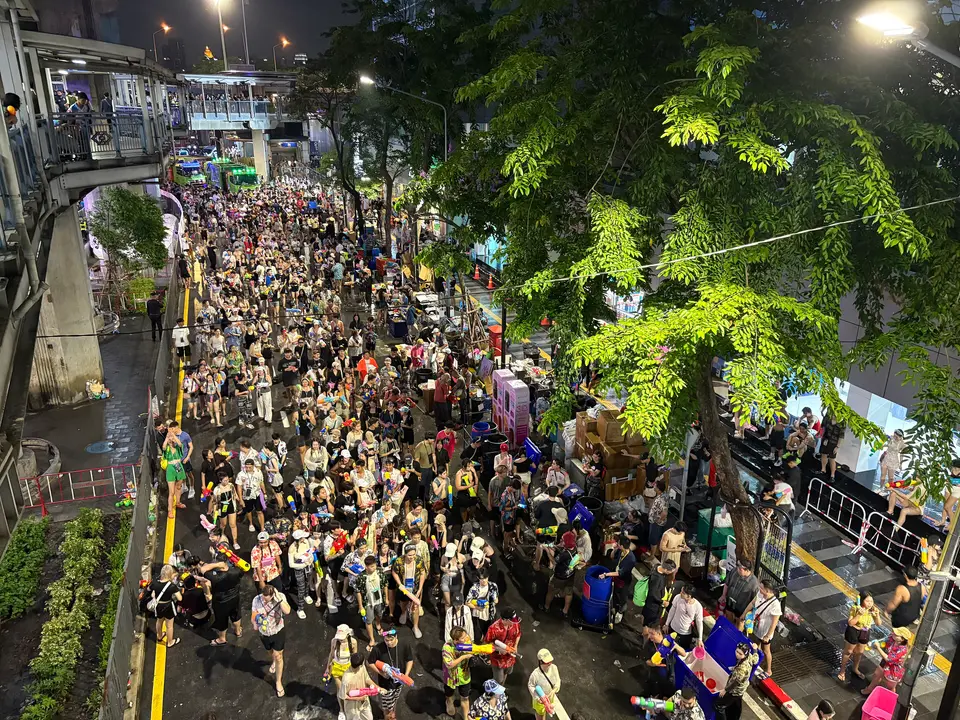
The traditional Thai New Year falls in mid-April, in the hottest weeks of the year. Families gather, pour water over the hands of their elders and over Buddha images — and in the streets, the gentle blessing becomes a nationwide water fight.
April 13 – 15, 2027Calculated
Pohela Boishakh
পহেলা বৈশাখ
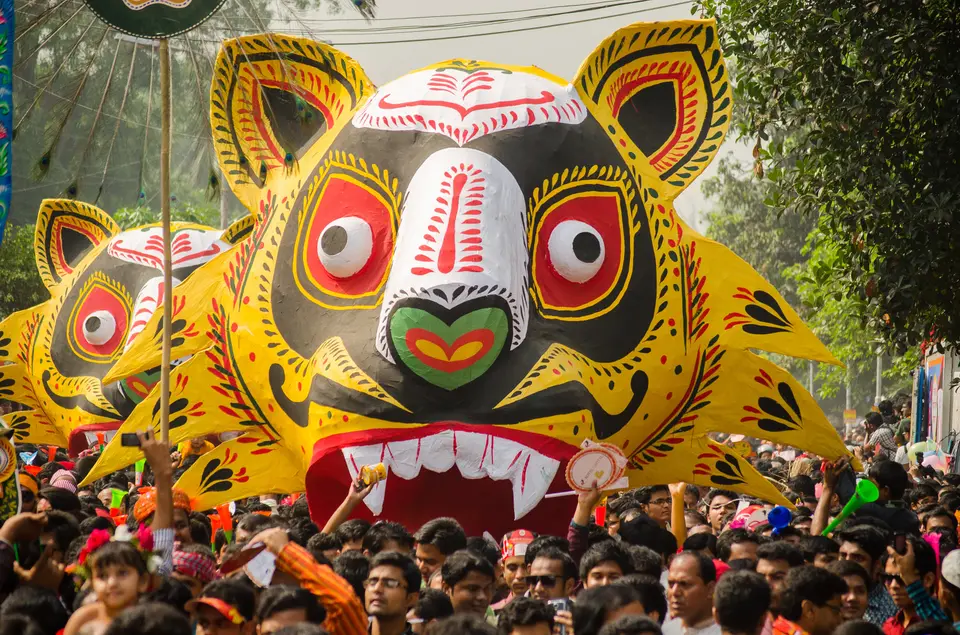
At dawn on 14 April Dhaka welcomes the Bengali New Year with Tagore’s “Esho he Boishakh” sung under the banyan tree at Ramna, then follows a procession of giant masks and floats — one for evil, one for courage, one for peace — made by the students of the Faculty of Fine Arts.
April 14, 2027Calculated
Comments
Have you been there? Tell other readers what to expect.
No comments yet.
Comments are read by the site’s owner before they appear.