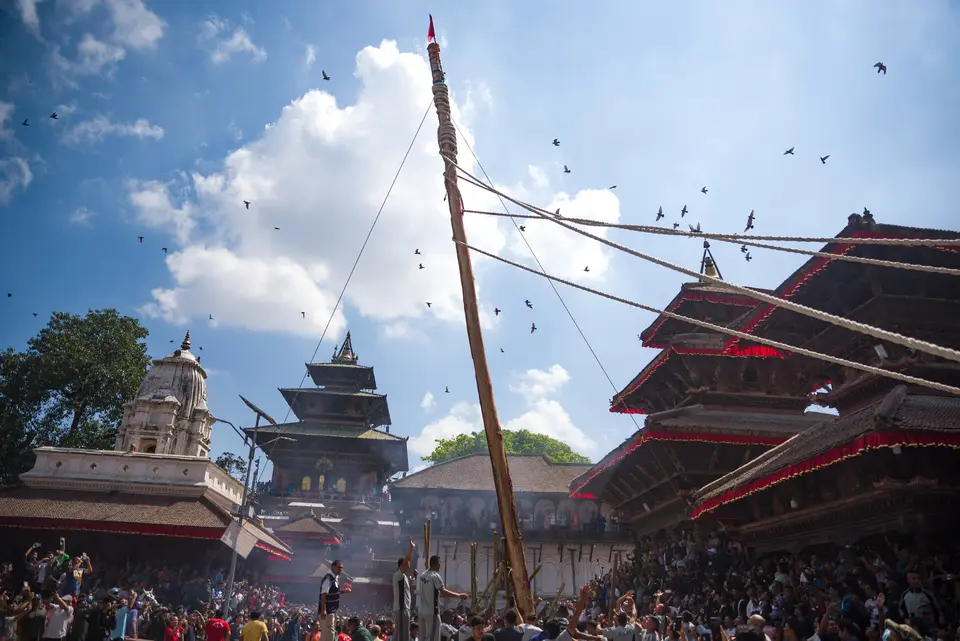
For eight days in the monsoon's last weeks, Kathmandu raises a stripped tree at the old palace, fills its squares with masked dances, and draws the chariot of the living goddess Kumari through the streets of the Newar city. It began as an apology to a god the town had tied up.
A god tied up in the market
The story told is that Indra came down to Kathmandu disguised as a farmer, looking for the parijat flower his mother wanted. He was caught stealing it at Maru, bound, and put on show in the square. His mother, Dagin, came down to look for him and walked the city. When the townspeople understood whom they had tied up, they let him go, and his mother promised the valley enough dew through the winter for a good crop. The festival is the apology and the thanks together.
The eight days open with the raising of the Yosin at Kathmandu Durbar Square — a tree brought from the forest, stripped of its branches and set upright in front of the old palace — and end when it is taken down.
Masks, chariots and a living goddess
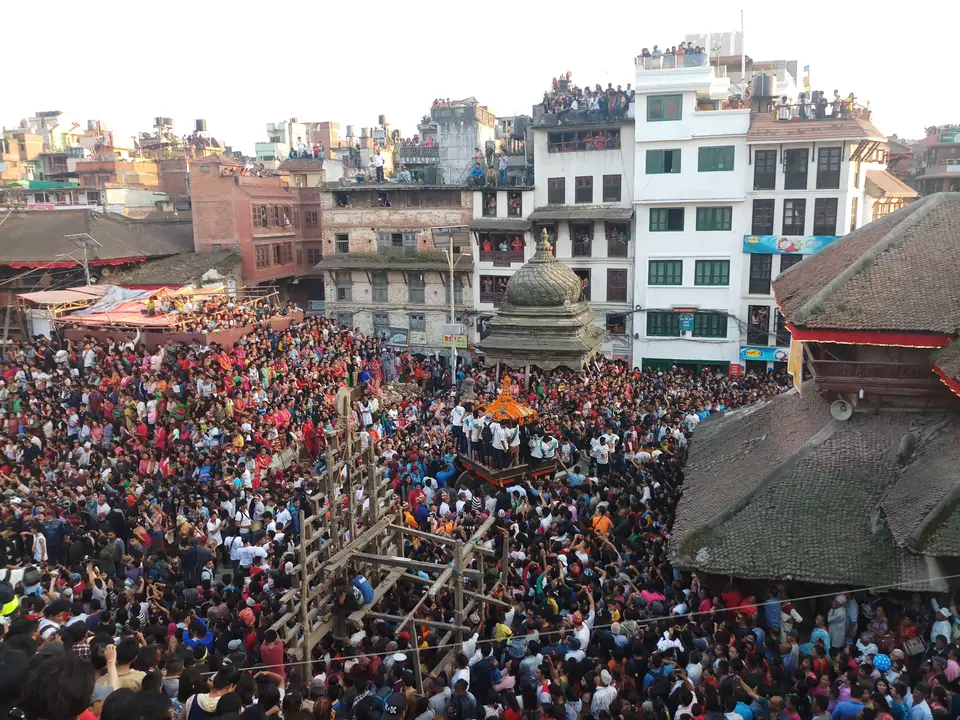
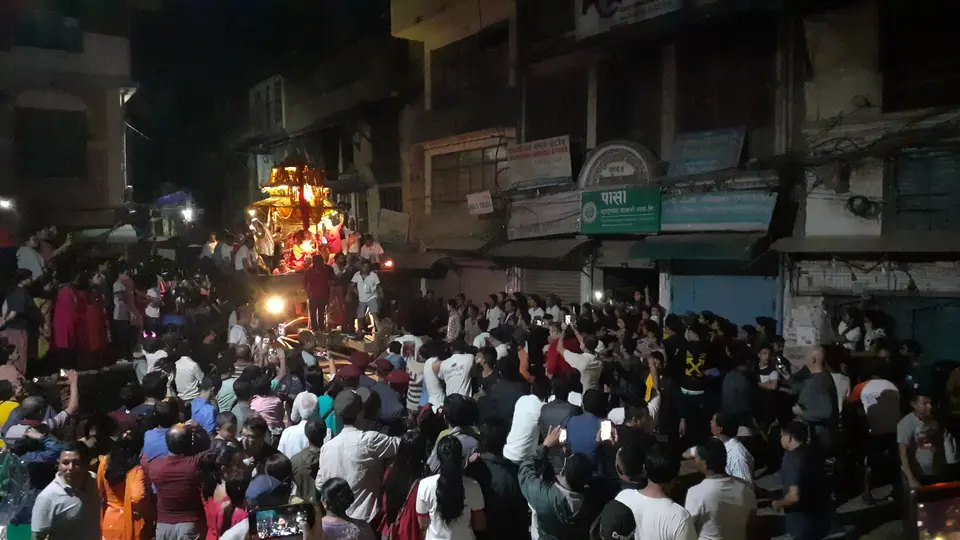
For three of the days the Kumari, the living goddess of Kathmandu, is drawn through the old city on her chariot: south on the first day, Kwaneyā; north to Asan on the full moon, Thaneyā; and through Kilagal in the middle on the third, Nānichāyā. Two other chariots, for Ganesh and Bhairava, go with her.
Around them the city fills with figures. Pulu Kisi, Indra's elephant, lurches through the lanes looking for its master. Majipa Lakhey, the demon of the Majipat quarter, dances in the squares. Great Bhairava masks are uncovered at several places, and from the mouth of Sweta Bhairava at the old palace rice beer runs on certain days of the festival. In the evenings the Dagin procession retraces the mother's search for Indra, walked by the families who have lost someone in the year that has passed.
When it happens
The festival is set by the lunar calendar and moves through September. In 2026 the public holiday, and the first day of the Kumari's chariot, is Friday 25 September; the pole goes up two days before and the festival closes at the end of the month.
When it happens
Indra Jatra runs eight days, from the twelfth day of the bright fortnight of Bhadra to the fourth of the dark fortnight, so it falls in September. In 2026 the day of the Kumari's chariot, which is the public holiday, is Friday 25 September.
- September 25, 2026Officially announced
Visiting with respect
Good to know
- The festival belongs to the old city, not to the tourist quarter. Watch from the edges of the squares and let the chariot teams and the dancers have the street.
- The Kumari is a child and a goddess at once. Do not call out to her, and do not use a flash.
- Ask before photographing the Dagin procession. It is walked by the families who have lost someone in the past year.
Avoid
- Do not stand in the path of the chariots. They are heavy, pulled by rope, and steer badly in narrow lanes.
- Do not push into the queue at Sweta Bhairava's mask for the rice beer. Who drinks and when is arranged by the people who keep the shrine.
Stay safe
- Kathmandu Durbar Square is very crowded on the main days and the old buildings around it are propped and fenced in places. Follow the barriers.
- Watch out for pickpockets and bag-snatchers in the crowds and on the buses.
- Protests and strikes are fairly common in Nepal and can stop transport at short notice. Keep an eye on local news during the festival week.
Sources
This entry was written from the following sources.
- Indra JatraWikipedia · read September 24, 2026
- Nepali public holidays 2083 BSHamro Patro · read September 24, 2026
- Nepal travel advice: safety and securityUK Foreign, Commonwealth & Development Office · read September 24, 2026
Related festivals
Kandy Esala Perahera
Esala Perahera
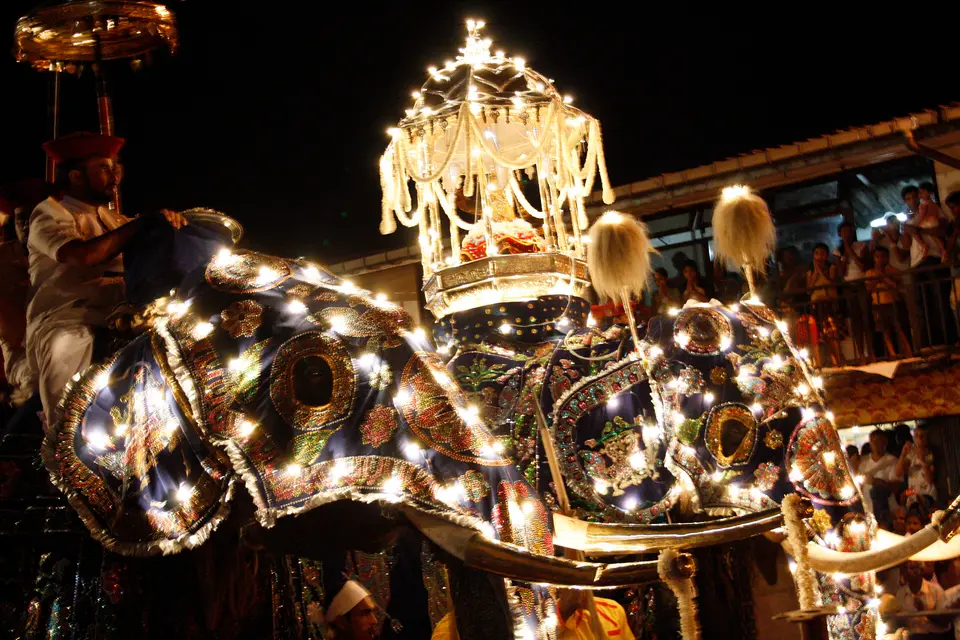
For ten nights the Sacred Tooth Relic’s casket is paraded through Kandy on the back of a great tusker, preceded by whip-crackers and fire dancers, Kandyan drummers and elephants in glittering caparisons, until the festival ends with a water-cutting ceremony in the Mahaweli River.
July – August 2027Approximate window
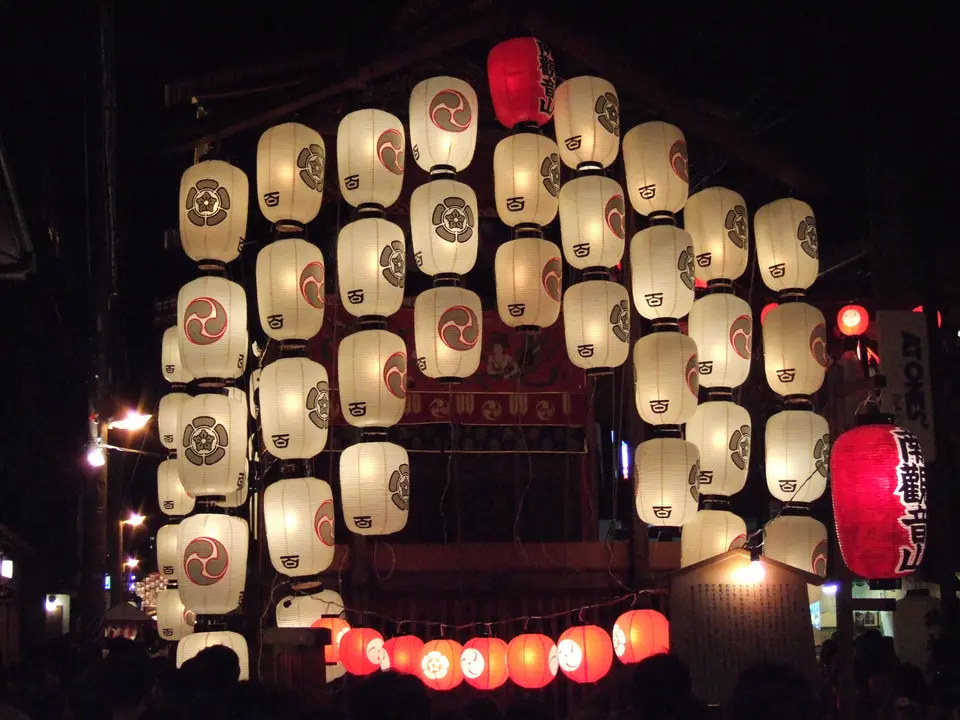
Gion Matsuri
祇園祭
Kyoto’s great summer festival lasts the whole of July. Its high points are the lantern-lit yoiyama evenings and the processions of towering yamahoko floats on 17 and 24 July, built and hauled by the city’s own neighbourhoods.
July 1 – 31, 2027Calculated
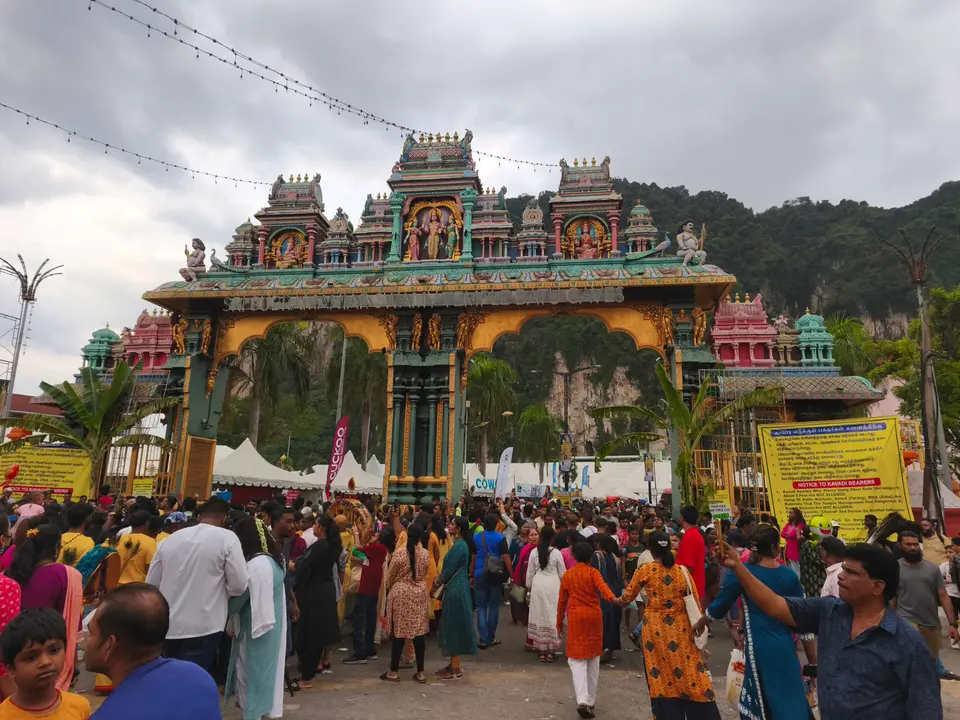
Thaipusam at Batu Caves
தைப்பூசம் (Thaipusam)
After 48 days of preparation, barefoot devotees of Murugan bathe in the river and bring their vows to his shrine at the Batu Caves — pots of milk, or kavadis up to two metres tall decked with peacock feathers — to drumming and chanting that carries some into trance.
January – February 2027Approximate window
Comments
Have you been there? Tell other readers what to expect.
No comments yet.
Comments are read by the site’s owner before they appear.